ELG Pond Issues 2013-2018
Larry@GlueLogix.com
elg@yahoogroups.com
This has many good articles, including the case for
gamefish vs. "nuisance" fish. They also discuss mosquito
fish, which came up last year.
http://www.ces.ncsu.edu/nreos/wild/fisheries/index.html
This is the PDF of a state printed manual that the USDA guy
showed me. It's old and hard copies are precious, but he
regarded it highly.
https://appliedecology.cals.ncsu.edu/wp-content/uploads/pond_mgt_guide.pdf
These are some other useful pages:
http://www.btny.purdue.edu/pubs/APM/APM-2-W.pdf
http://ohioline.osu.edu/a-fact/0014.html
"Prevention is the key to eliminating the need for costly, annual
control measures to eliminate a nuisance duckweed and/or watermeal
problem. Two prevention strategies involve nutrient reduction and
aeration."
"Manual control involves physically removing the duckweeds or
watermeal from the pond. Because of the explosive growth pattern of
these small plants, few pond owners succeed in having manual removal
solve their problem entirely. Best results are obtained if the owner
regularly removes the duckweeds as they begin to become apparent. If
attempted, it should be done on a day when wind has pushed the
duckweeds to one side of the pond. Keep in mind that duckweeds
thrive in protected ponds, so an owner may have to wait for a very
windy day to try this. Once the duckweeds are pushed to one side,
take a fine mesh dip net and start removing. Long-handled swimming
pool nets work well. Remove as much as possible, and repeat the
process as needed."
http://www.clemson.edu/extension/natural_resources/wildlife/publications/fs19_managing_farm_ponds.html
"If alkalinity and pH are low, the addition of powdered,
agricultural limestone should raise pH and alkalinity. Do not use
quick or slaked lime because these compounds can cause rapid pH
changes which may kill the fish. The amount of lime needed depends
on chemical characteristics of bottom sediments or mud. You must
take a soil sample from the pond bottom and have it analyzed to
determine how much lime is required."
"It is not possible to over treat a pond with agricultural limestone
because limestone does not dissolve once the pH reaches 8.3."
"Lime must be spread evenly over the entire pond so it can react
with the bottom mud. Because limestone dissolves slowly and is
washed out of the pond with overflow water, repeat treatments every
3 to 5 years. Another alternative is to spread 1/4 the original
application of lime into the pond each year."
http://extension.psu.edu/natural-resources/water/converted-publications/water-quality-concerns-for-ponds
"In general, most pond water can hold about 10 to 12 mg/L of oxygen.
Dissolved oxygen is reduced by the biological decay of organic
material such as decaying
plants and animals or animal and human wastes. Dissolved oxygen
levels below about 6 mg/L can begin to have detrimental effects on
pond life."
"A lack of dissolved oxygen is the most common cause of fish kills
in ponds. This occurs frequently when aquatic plants and algae die
in the summer or when they are treated with aquatic herbicides."
http://www.proskim.com/how_it_works.html
http://en.wikipedia.org/wiki/Bream
http://en.wikipedia.org/wiki/Watermeal
County Extension Service
The NC State Cooperative Extension Service is an extension of NC
State crop science into the rural community. Its purpose is to
help farmers make a living, not to help suburban hippies go
swimming. It has all the expertise and tests we need, but we
have to careful what we ask for and what answers we accept at face
value. The Hillsborough extension office is in back at the
county offices on Revere Road, in the same parking lot as the old
animal shelter.
http://orange.ces.ncsu.edu/
Orange County Center
306-E Revere Rd
Hillsborough, NC 27278
(919) 245-2050
(919) 644-3067 fax
Office Hours: 8-1 and 2-5 Mon-Fri
Google
Map
Water Tests
Parameter
|
2013
|
2014
|
2015
|
2016
|
2017
|
2018
|
Range
|
Spring pH
|
5.04
|
5.68
|
N/A
|
N/A
|
N/A
|
N/A |
6.5 - 9.0
|
Pond pH
|
5.20
|
6.84
|
6.19
|
6.73
|
6.41
|
6.49
|
6.5 - 9.0
|
Pond water Hardness
|
9
|
50
|
29
|
24.4
|
17.7
|
20.5
|
50 - 150
|
| Pond Inorganic Nitrogen |
0.94
|
0.09
|
0.61
|
0.77
|
0.83
|
0.61
|
?
|
| Pond Organic Nitrogen |
0.41
|
0.27
|
0.36
|
0.16
|
blank
|
blank
|
?
|
Between 2013 and 2014, we limed.
Between 2014 and 2015, we applied a biological treatment.
In 2015, the Spring was not running, so there is no Spring pH.
Between 2015 and 2016, we applied dye and fluridone.
In 2016, we applied dye and one liter of Sonar RTU as a fluridone
"booster"
The watermeal stayed away in 2016, but there
was a slimy algae bloom in August
50 pounds of food grade diatamaceous earth was
applied in late August. Algae went away by late September,
but that could have been time too.
In July 2017, we applied dye and 100 pounds of diatomaceous earth
against the 2016 slime.
The sample was late at 05July, due to cool and
rainy conditions throughout June.
In late August, the slime had not returned.
In July 2018, we repeated dye and 100 pounds of diatomaceous earth
There was a little more brown algae than 2017
in August 2018, but also a lot of pollen, and it was hard to tell
them apart.
120 pounds of lime were applied each month from
Jan to July 2018. It did not seem to affect the pH, which
was similar to recent years with good rain.
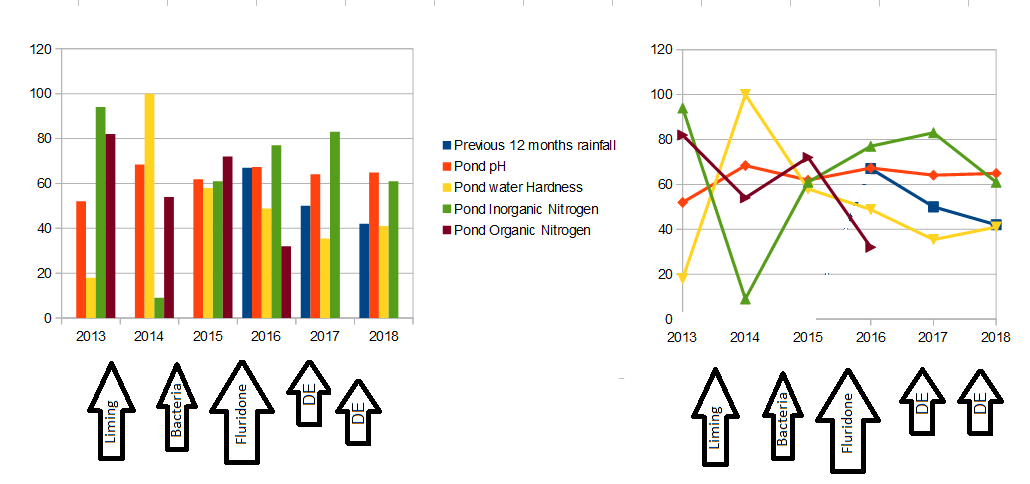
Over time, it looks like the major 2013 liming raised both pH and
hardness. Hardness is falling steadily rose in 2018 after
several months of incremental liming. pH is now self
sustaining around the bottom of the band, after falling way low
during the drought years.
Not sure what caused the big change in nitrogen 2013-14.
Doesn't seem like liming would have done that, but the bacteria
was not ordered until Oct 2014.
See below for extended discussion of Nitrogen reference ranges.
Blog
Summer 2017
After a cool and rainy June, the annual water sample was taken on
05Jul2017. After the sample was taken, half a gallon of
Aquashade dye and two 50 pound sacks of Diatamaceous Earth (DE)
were applied. The water sample shows that 2016's DE had no
obvious affect on pond pH, which seems to be varying randomly
beween 6 and 7 (slightly acidic). Hardness continues its
downward trend, along with other mineral measurements not shown on
this graph. Organic Nitrogen was not filled in this year,
but Inorganic Nitrogen has nearly returned to pre-lime
levels. The state agronomist is recommending lime again, as
she did in 2016. See the
report for full details.
As of 20Aug2017, no bacterial slime has emerged, so maybe the
early DE treatment was a good idea. Watermeal has not
returned.
Summer 2016
One liter of Sonar RTU was applied as a "booster" and the
watermeal stayed away!
Booster: https://smile.amazon.com/gp/product/B004XWS5DU/ref=od_aui_detailpages00?ie=UTF8&psc=1
A slimy blue-green algae (aka cyanobacteria) layer bloomed in
August. 50 pounds of food grade diatamaceous earth (DE) was
applied and the bloom was gone by mid September. It may have
been time or the DE. If Hardness goes up in 2017 it's
because of the DE. The DE was purchased on ebay. It
was $50 for a 50 pound sack, free shipping. The sack was
marked as an animal feed additive against caking. Local feed
stores do not have pure DE, but a mix of DE and "bentonite", which
is clay.
Fall 2014 through Spring 2016
This report emerged
from a Pond Committee meeting at Art and Marion's house.
It recommends fluridone unless electricity could be installed at the
pond. Investigations that Fall showed that the cost of installing
electricity at the pond is prohibitive. Biological treatment was
added Oct14. At the Association meeting in January 2015, funds were
allocated for fluridone treatment. Treatment was made in Summer
2015. Most of the watermeal died back before winter. As of early
April 2016 it has not returned.
Bacteria: http://www.newtechbio.com/catalog/lake-and-pond-c-3/ntmax-biological-lake-pond-digester-25-pound-pail-p-20.html
Fluridone Treatment: http://www.newtechbio.com/catalog/duckweed-pondweed-control-c-7_9/32oz-quart-alligare-fluridone-duckweed-weed-killer-up-to-2-acre-control-free-shipping-p-53.html
17Aug14 Skimming
The first time we skimmed the pond, we pulled
the watermeal up with seives. Today I tried a couple
of other things:
Buckets
This is a good, low tech solution. By pushing an empty
bucket down into the water and carefully pushing the lip
down just enough to let the watermeal flow in, we can
collect a lot of plants quick with not too much extra
water. The bucket in the pictures is 5 gallons with no
handle. I picked it for its color since I was taking
pictures. On a real workday we could use smaller
buckets and set up a brigade.
This is the bucket at first:
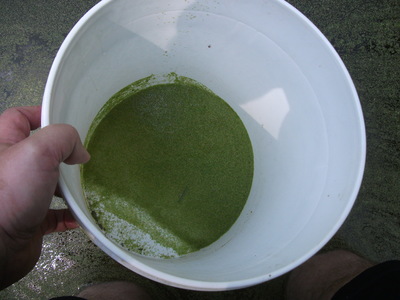
This is the water going into the bucket.
It makes its own little current. MP4 format, 6MB:
FillTheBucket.mp4
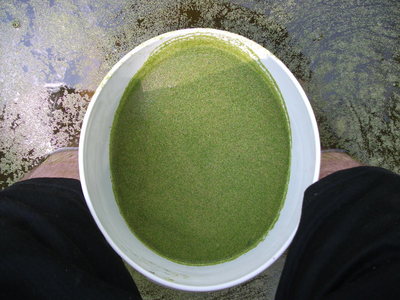
This is the bucket full. The watermeal is
more concentrated inside the bucket than on the surrounding
water:
Vacuum
Wet dry vacs do a decent job too. It seems to me
that a few big vacs would outdo a bunch of buckets. I
experimented with the ones I had here, but something like
this guy ($100 from Home Depot) would be the workhorse:
http://www.homedepot.com/p/Stanley-10-Gal-Stainless-Steel-Wet-Dry-Vacuum-SL18014/204226957#specifications
This one is 5.5 HP, which translates to 4100
Watts (google: 5.5 HP to watts). That means you could
run it off a fairly big generator like my 6500 Watt unit:
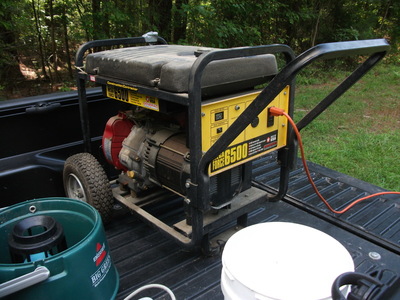
A smaller vacuum could be run off almost any
vehicle given a big inverter. This one from Amazon is
similar to other ones I've used and seems to be the top of
the price/performance curve. 3500 watts equals 4.7 HP,
so this one won't quite power the big Stanley vac, but most
wet vacs are weaker than 4.7 HP.
http://www.amazon.com/Power-Bright-PW3500-12-Inverter-3500/dp/B000NHS9R6
I tested the vacuum technique with two small
vacs I had on hand. It seems to work well. the
small yellow vac filled up in about 30 seconds, and the big
one took about a minute. Towards the end, I figured
out how to float the nozzles so only the very top of the
water flowed up the vacuum hose (see the RugCleaner film
below). In both these photos, the watermeal in the
bucket is much denser than it was in the water I was working
on, which "proves" that we can skim watermeal without
pumping the pond dry.
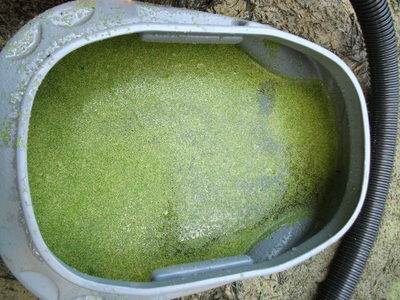

You can see how the suction worked in the
films. MP4,
about 3 MB each:
Small Vacuum Suction
Rug Cleaner Suction
Disposal
So we go down the hill and scoop a few pails of
water. What then? We could just toss it in the
woods over the dam. Or, we could strain the watermeal
out and let the water trickle back into the pond, aerating
itself on the way. The trick is finding a really big
strainer. I think something like this would work,
maybe lined with landscape cloth. It's $30 at Home
Depot, measures about 4x8 feet flat and 2.5 feet tall:

http://www.homedepot.com/p/WM-Bagster-Dumpster-in-a-Bag-775-658/202228840
If we put this up on the bank and dump the
buckets into it, the watermeal would mostly stay in the bag
and the water would mostly flow back into the pond.
We could also line a pickup bed with landscape
cloth and get the same effect, but just drive the watermeal
away when the job is over.
Cleanup
A few minutes with a hose and everything is back to normal.
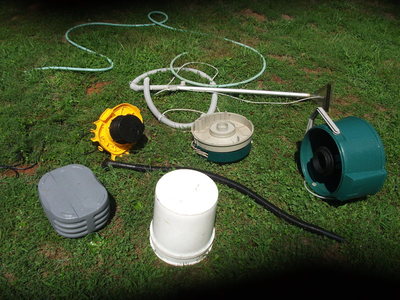
14Aug14 Oxygen Tests
Email to Pond Committee
In our ongoing discussion and learning about the pond, I have
raised the issue of oxygenation a time or two. I finally
decided to buy an aquarium O2 test kit ($25 for 60 tests) and see
what I could make of it.
http://www.amazon.com/gp/product/B001EJ3DQ4/ref=oh_aui_detailpage_o04_s00?ie=UTF8&psc=1
The test is pretty subjective, because the last step is matching
color against a printed strip. Depending on how I read it,
the O2 level at 18 inch depth was 4 or 6 ppm after yesterday's
full day of sun, and 2 or 4 ppm this morning. I need to
figure out how to get deeper samples, but I don't expect them to
be any better.
These extension service links from TX and KY explain why the O2
changes overnight, and have the same O2 guidelines: 4 ppm is the
lowest reliable O2 level for fish. They stress at 3 and die
at 2. My kit only goes down to 2 and it's possible that it
shows 2 for anything 2 and under.
http://www2.ca.uky.edu/wkrec/RecreationalFishProduction.htm
http://www.extension.org/mediawiki/files/2/2f/ManagementRecFishPondsTexas.pdf
So I'm still against adding fish, because I see it as throwing
them in there to die. No progress on cheap aeration yet, but
I didn't want to start anything until getting some initial data.
For the record, I'm with Trace on the standpipe, and believe that
a new open top standpipe would strain some-to-most of the
watermeal off the pond surface, as long as the pond level is
up. But I'm skeptical that it can be fixed without draining
the pond and disturbing the dam. The folks I talked to about
that were clear that dam work is not a job for amateurs. But
if it's possible to slip a new plastic pipe inside the old metal
one, I say let's go for it.
I ran into Scott and Audrey when taking this morning's
sample. Scott is currently enthusiastic about an herbicide
treatment against the watermeal. That came up in my reading
too but I always assumed the group would be against it. It's
about as expensive as a load of fish, and has to be applied by
experts, but it seems to be safe for the fish and widely used for
clearing ponds of duckweed and watermeal.
12Jul14 Received second year water test report
Full
report here:
http://www.gluelogix.com/ELG/Pond/ElgPondWaterTestResults_2014.pdf
Thanks to Scott's work liming the pond, the pond's pH is now in
range. We want 6.5 to 9 for a fishpond, and the new reading
is 6.8. Water entering the pond is still acidic, so the lime
is making all the difference. The Nitrogen is also way down.
Parameter
|
2013
|
2014
|
Spring pH
|
5.04
|
5.68
|
Pond pH
|
5.20
|
6.84
|
Pond water Hardness
|
9
|
50
|
| Pond Inorganic Nitrogen |
0.94
|
0.09
|
| Pond Organic Nitrogen |
0.41
|
0.27
|
There is still work to do. The watermeal is back, but I
have not seen the red tide or weird white blobby things that were
there last year.
15Aug13 received soil test report
The recommendation is 3
tons per acre. I called Scott right away. Since
we estimate the pond to be one half acre, the prescription is 1.5
tons. He is going ahead.
01Aug13 email from Carl Matyac PhD, County
Agent
This is a standard soil test....no charge. Will be going to
the lab first of next week.
Late July 2013
I took my time building the sample scooper and fixin-ta go take
the samples. When I finally did it, the mud took 2 weeks to
dry enough for their lab process. I couldn't exactly leave
it out in the sun to dry, given the weather this year.
11Jul13 email from Carl Matyac PhD, County
Agent
Your technique is right on. Most documents I
have seem all deal with fields or gardens.
The final sample after mixing subsamples should be about 2
cups.
Thanks
Carl
On Thu, Jul 11, 2013 at 8:42 AM, Larry Martin <Larry@gluelogix.com>
wrote:
Hi, Carl -
Do you have a link to guidelines for taking soil samples? How
much soil do you want?
Just guessing without any guidance, I think I will:
* rig a tin can to the end of a pole
* take bottom samples at 4 or 5 points in the pond, at various
depths
* mix them in a bucket
* let the dirt dry out in my garage
* wrap it up and bring it in
If you don't tell me different, I will be by sometime next week with
a quart or two of samples.
Thanks for all your help,
Larry
On 7/9/2013 4:06 PM, Carl Matyac wrote:
Brenda Cleveland has included some additional remarks on your
report.
Looks like she is asking you to collect the soil on the bottom of
the
pond to determine lime recommendations.
Larry note: Another source said that "tin cans" are bad because
they contaminate the sample with trace minerals. That
article recommended stainless steel. I finally went with a
plastic Folgers tub.
10Jul13 email from Brenda Cleveland, NC Agriculture dept
This note refers to the annotated
water test report sent a couple of weeks after the original
one, which tells us how to submit a soil sample:
Larry,
We measure NH3 (ammonia) and report NH4+ (ammonium). The relative proportion of NH3 to NH4 depends upon pH (i.e.: whether it is ionized (NH4+) or unionized). Ammonia becomes more toxic as pH increases (NH3 is formed in basic waters); NH4 is more prevalent in acidic waters. Generally, NH4 <2.0 ppm and NH3 <0.1 ppm are acceptable. Please contact the fish specialist through your extension office for further assistance. I don't know anything about pond management and just provide what my references say.
Brenda R. Cleveland, Chief
Plant, Waste, Solution and Media Section
NCDA&CS Agronomic Division
Brenda.Cleveland@ncagr.gov
919.733.2655
E-mail correspondence to and from this address may be subject to the North Carolina Public Records Law and may be disclosed to third parties.
Please don’t print this unless you really need to!
-----Original Message-----
From: Larry Martin [mailto:Larry@GlueLogix.com]
Sent: Tuesday, July 09, 2013 7:07 PM
To: Cleveland, Brenda R
Cc: Carl Matyac
Subject: Re: Solution Report (S000692)
Hello, Brenda -
Thanks very much for adding reference ranges to the Agronomist Comments
section of my lab report. I will work on getting pond bottom soil
samples in to the Orange County Extension Office.
I see in your expanded comment that NO3 <3ppm is favored for fish
production. Can you tell me what the equivalent ranges are for NH4 and
Urea?
Best Regards,
Larry
Larry Martin
www.GlueLogix.com
Design, Test and Support of Computerized Systems
desk/cell USA 919.342.0201
skype larry.martin.gluelogix
On 7/9/2013 3:29 PM, brenda.cleveland@ncagr.gov wrote:
Revised Solution report is attached.
09Jul13 email to ELG
list
After I asked a few questions of Dr. Matyac, the County Extension
Agent, he volunteered to get more detail on our water test from the
North Carolina Agriculture Department, the testing body. They
have sent us a revised water test report including reference ranges
for fish production:
http://gluelogix.com/ELG/Pond/ElgPondWaterTestResultsAnnotated.pdf
They say our pH is low. Slightly acid water like ours is OK to
splash on crops, but it stunts fish growth. We are also low on
other minerals, most of which will be corrected by a good
liming. Now that the agronomist knows what we are trying to
accomplish, she recommends we take samples of the pond bottom soil
so she can recommend how much lime to add. I'll be looking
into that real soon, unless someone else wants to take over.
I still get the sense that our needs are unusual as far as the
extension folks are concerned. Dr. Matyac was telling me about
pond water that was so high in nitrogen that it supported algae
growth that choked irrigation pipes. That was 100 ppm.
We are around 1 ppm nitrogen, so he thinks we're in good
shape. But it turns out the agronomist says 0.3 ppm is a good
guideline _for fish_,
and we are over that. It's confusing. I think we should
lime and see what happens.
To close the loop with Joyce's son Pete Crawford: he has weighed in,
saying that he is an engineer, not a biologist ("damn it,
Jim..."). He will be able to help us with aeration and
drainage issues when we get that far, but not with pond chemistry,
ecosystems, or invading species. His full note is below.
Larry
08Jul13 email from Pete Crawford
Dear Larry,

I have been out of the office for the past two weeks, and am now catching up on my emails.
Unfortunately, I am an engineer, and I know little of invasive species in ponds.  I would have hoped that your local extension agent had some helpful information for you.  But, I recommend asking him for references.  Surely he has contacts at NC State or other Extension agents who are experienced in biological water quality issues.

Best of luck to you,
Pete
02Jul13 email from Carl Matyac PhD, County Agent
Finally got to your email.
This is a quote from the article on alkalinity that you
referenced. I'll confirm that this is a good approach.
"The most reliable way to determine the amount of
agricultural limestone needed is to take several soil
samples from the pond bottom. Collect the samples as
you would for cropland and submit them to your county
extension agent or a university soils lab for
analysis. To get the correct recommendation, request
the liming requirement suggested for “alfalfa
production.” The amount of agricultural limestone
needed to grow alfalfa should equal the minimum required for
the production of most aquatic animals. The best (and
easiest) time to lime your pond is before you fill it with
water. Agricultural limestone should be distributed as
evenly as possible over the entire pond."
The blog pics are good. Now I see your concern.
Your references are better than what I have been reading.
I will share your pond results with some more experienced folks.
I will be in touch.
Carl
Larry Note: The soil samples from the pond bottom, which led to
the 1.5 tons of lime recommendation, were collected in Joe's kayak
with a coffee can on a long stick, strained through one of
Marinda's old stockings, and dried to the consistency of Play Doh
before taking to the extension office.
01Jul13 email reply to Carl Matyac
Hi, Carl -
Thanks for sending this ppt. To go with the way things are
framed here, I think we mainly want the pond to function for
Swimming (p11) and have convinced ourselves that a healthy fish
ecosystem will help with that. Nobody wants to drink the water, but
we want to not-worry about accidentally swallowing a little.
We are not raising the fish for food or cash, we just want them to
keep the pond nice for us. That worked until a few years ago.
I did a little reading while the test was out. I think our
pond pH is too low. The spring pH is even lower, but you can't
control that. This shows pond pH as a curve, peaking in "late
PM":
http://www2.ca.uky.edu/wkrec/AlkHardness.htm
We took our samples at 6 PM on a sunny day. The pond should
still have been alkaline. Our numbers for Alkalinity and
Hardness are both about 1/5 of desired levels per the same page,
right above the curve.
The desired
total alkalinity level for most aquaculture species lies between
50-150 mg/L CaCO3, but no less than 20 mg/L.
I had trouble evaluating Nitrogen. You cite 100-scale ppm
readings, but this page has numbers more on par with our results:
http://extension.psu.edu/natural-resources/water/converted-publications/water-quality-concerns-for-ponds
Nitrate-nitrogen
concentrations above 3 mg/L are indicative of pollution. Phosphate
concentrations as low as 0.01 mg/L may be sufficient to increase
plant and algae growth.
I'm equating ppm with mg/L, and probably missing the significance of
specific tests and chemicals. I know I'm not the expert
here. But it's hard for me to believe our pond is so clean,
given the watermeal explosion that kicked this whole thing off:
http://gluelogix.com/ELG/Pond/
I will try to drop by midday tomorrow (Tuesday) and go over the
results, if that works for you.
Thanks again,
Larry
01Jul13 email from Carl Matyac PhD, County Agent
Larry:
I have attached a short
powerpoint in
water quality from PA since the explanations by the NCDA are
rather abbreviated. Water quality has become a
relative term depending on where the water comes from and
what you want to do with it. Drinking water standards
are mostly evaluated by the number of coliform
bacteria. That has not been tested. The rest of
the parameters are very good.
Nitrate for example
is ok at levels <100 ppm; you have less than one
ppm! Things like CaC03 is important if you want
to adjust the pH of the water or want to reduce the Ca
levels so the water does not clog up irrigation lines.
Most of the samples I see are green and slimy and have cows
dumping in the water on a regular basis. So in
comparison your sample is mighty clean.
Looks like the NCDA will do Cd, Pb, As and Cr upon
request. (See "other results") That might be
interesting.
The Health Department's web site may do a better job of
answering some of your concerns but most of their testing is
done on wells not springs or ponds.
http://www.co.orange.nc.us/envhlth/inspections/WellWaterTestingFAQs.asp
Then there is NCDENR and EPA. Neither of these agencies
will do any testing but they have lots of words about
guidelines.
Let me know what you think and we can look at this from another
perspective.
Carl
Larry Note: Later discussions narrowed down that Nitrate
number. 100 ppm is "good" for irrigation because it is not
so high that algae grows in the hoses and blocks them. Fish
and recreation ponds need to be much lower. 3 ppm is
regarded as "polluted" per some other sources.
27Jun13 email to ELG List
The extension agent is on vacation until next week. I sent a
copy to Pete Crawford, who hasn't replied. So I am going to
take a chance and say what I think of the results. The big
problem is that the report does not include reference ranges, so I
have had to Google vigorously to find out what the numbers might
mean.
_I
think_ the water coming in
from the spring is acid, soft and high in nitrogen, and it's moving
the pond in that direction over time. From my reading I think
we need to:
* apply agricultural limestone
* seive out the watermeal
* do something to circulate bottom water
* stop fertilizing for a while
That's my suggestion. I'm not proposing that ELG take action
until we get word from our experts, but we should be getting ready
to do a little work and spend a little cash.
Referring to the water test report at:
http://www.gluelogix.com/ELG/Pond/ElgPondWaterTestResults.pdf
pH: The pH of the Spring water (page 1) is 5.04, that of the Pond
water (page 2) is 5.20. That's pretty acidic. For
comparison, Wikipedia says that baking soda is pH=9, pure water is
pH=7, black coffee is pH=5, and orange juice is pH=3.
I saw a graph that shows that "healthy" pond pH tends to swing 6-9
during a sunny summer day, peaking in mid afternoon. We took
these samples at 6 PM, when pH should have been well above 7.
That makes me wonder how low it goes when the sun is down.
Alkalinity and Hardness: work together to buffer acidity. Both
should be at least 5x our numbers, and can be boosted with
agricultural limestone (NOT quicklime or anything made for swimming
pools!), which would also raise our pH, in a gradual and sustainable
manner.
Nitrogen: This was the hardest reference range to nail down.
Web pages give all kinds of numbers, seemingly based on specific
tests, but this one seemed closest to our situation:
http://extension.psu.edu/natural-resources/water/converted-publications/water-quality-concerns-for-ponds
any measurable
amount of ammonia-nitrogen above 0.1 mg/L can be detrimental to
the pond’s health.
Nitrate-nitrogen concentrations above 3 mg/L are indicative of
pollution.
I think mg/L is the same as ppm for our purposes. If I'm
reading this right, our pond is halfway to having a "polluted" level
of nitrogen at 1.35 mg/L total nitrogen, most of which is coming in
at the spring. Since Phosphorous is also high, we should probably
not add any more of either for a while.
Maybe the experts will say that I'm wrong when they weigh in, but
that's how it looks to me right now. I'll be pricing limestone
and following up with our contacts, but may not have a lot more time
to share in the near future.
Thanks,
Larry
25Jun13 email to Pete Crawford
Hi, Pete -
I have been working with Dr. Carl at the extension office up here in
Hillsborough to try and get on top of our pond issues. The
latest thing is an infestation of water meal. The doctor is
starting to say he's not a big pond expert, so I guess it's getting
to be time to ask him to call you. Does that sound about
right?
In the meantime, we have the attached water sample reports.
Sample 1 is the "spring" where water seeps out of the ground, a foot
or so above the pond level. Sample 2 is from the center of the
pond, about 12 inches below the surface. Both samples were
taken around 6 PM.
Here are pics of the pond last week or so. It looks more green
now, and less brown:
http://gluelogix.com/ELG/Pond/index.html
What do you think?
25Jun13 email to ELG List
The pond water test is back. If you're interested, you can get
it from:
http://www.gluelogix.com/ELG/Pond/ElgPondWaterTestResults.pdf
I have to go over it with the extension agent before volunteering
any analysis. More soon.
Larry
17Jun13 email to Pond Committee
If you want to meet, I can do Thursday at 7:30, at the pond.
That's the first day with no rain forecast, anyway.
I got some good info from Dr. Carl at the extension office -
* rotten egg smell (reported last year) is hydrogen sulfide gas,
associated with anaerobic biological activity, i.e. low oxygen
content somewhere, maybe in the depths of the pond.
* Our green bits are water meal, not duckweed, but it doesn't make a
difference. The brown stuff is another algae buoyed up by the
green stuff, and he doesn't know what the white stuff is a-tall.
* He recommended a USDA water test. It's $5 and I have to take
the sample. I'll be doing that sometime when it's not raining.
* The spring that feeds our pond is a big variable. It's not
necessarily from a deep source - it could easily be runoff coming
back to the surface. As such, it could be carrying
more/different nutrients from all the newly cleared land around
us. The USDA test measures N-P-K levels, so will tell us if
the pond is overly fertilized.
see you thursday?
Larry Note: Only Larry and Lori attended the meeting.
17Jun13 email to ELG List
Some of you may have noticed that the pond is in pretty bad shape
right now. I have not been down there since it got warm out,
but Scott says it was ok until sometime last week. It smells
decent, even though it looks like it should smell pretty bad.
There are minnows at the beach, and you can hear big fish jumping
here and there. Scott says there are a good number of young
catfish. So overall, the problem is either not functional or
not very far progressed.
To try and get on top of things, I took some pictures and went to
the county offices on Revere road, talking to the USDA and NCSU
extension folks. The county extension office (of NCSU) says
they will diagnose our aquatic weed problem if they can see
samples. I'll be taking care of that tomorrow.
Small versions of the photos are posted here, along with links if
anyone is interested:
http://gluelogix.com/ELG/Pond/index.html
Larry
P.S. I did connect with Pete Crawford (Joyce's son) after the last
ELG meeting, thanks to Art and Marion. He can come up and help
us, but the process is that the local extension office has to
request him. I decided to wait until it warmed up to open a
case with them, then things got away from me. We'll see what
happens now. L.
17Jun13 email to Pond Committee
(Committee = Larry, Art and marion, plus
Trace and Lori as ELG Officers)
The pond looks pretty bad, for sure. I took pictures and
will post tonight. The good news is, we now have an aquatic
plant problem. There are experts to help with this. Our
complaints before were a bit vague, but we can get help now.
Scott B. says he has been fertilizing the pond every year to keep
the surface algae under control. He thinks the heavy rains
this year diluted and washed out his application. He also says
that this real bad state has just come up in the past week, which
further impeaches the rains. Scott agrees that there are fish
in the pond, including some grass carp. He does not know if
any of our new guys survived the winter, but we agree that the pond
has not kicked over dead, despite how it looks.
After talking to Scott, I went to the USDA county office and the NC
State coop. extension, both at 306 Revere Road in
Hillsborough. The USDA guy thinks we have duckweed:
http://en.wikipedia.org/wiki/Duckweed
If you walk over to the spring it looks more like the wiki pictures.
USDA guy says that duckweed shows up red or brown when it's coming
in, and that explains the red tide looking stuff. Nobody knew
what to make of the white slimy things.
The Extension office said to take some samples in mason jars and
bring them in. They may be able to diagnose on the spot.
If not, it will cost $20 to send the samples out. I will take
care of that tomorrow, then we can talk about a meeting, ok?
I also got some other info that I will try to sort through tonight.
Thanks,
Larry
17Jun13
The pond looks pretty bad. Scott says it just happened in the
last week. The USDA guy thinks it may be duckweed, but I am
going to take samples to the County Extension Office tomorrow.
http://en.wikipedia.org/wiki/Duckweed
This photo does not capture the brown-ness of the pond right now.
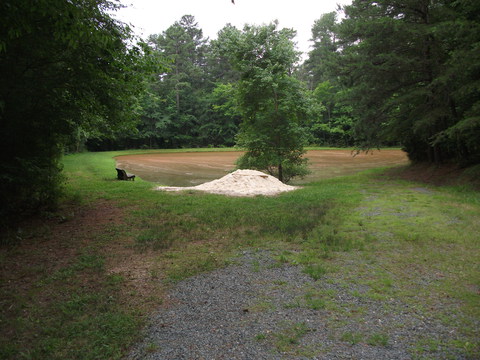
This really reminds me of home - Toxic Avenger country.
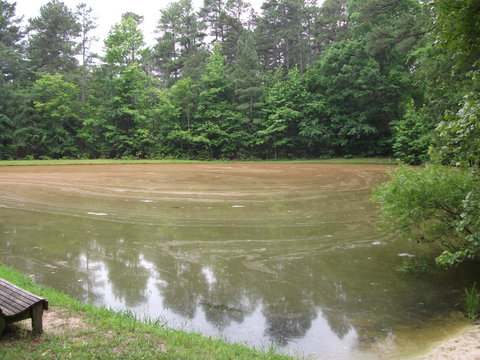
The beach needs raking again, if anyone wants to get in the
water. You can't see but there are a surprising number of
minnows.
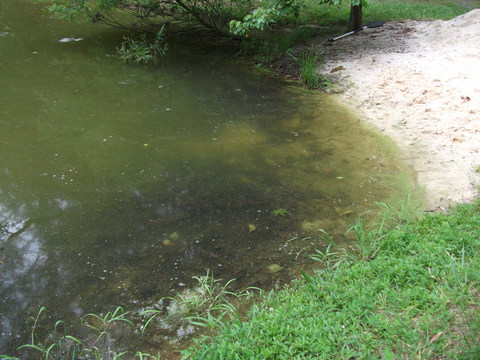
Home sweet home...
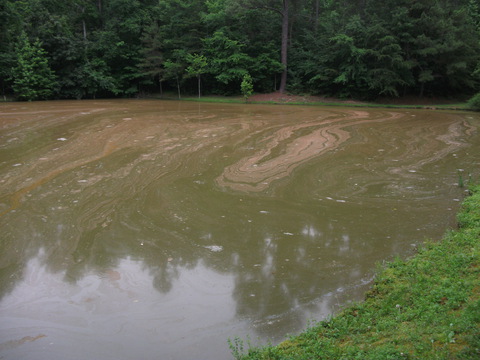
I don't even want to know what this is.
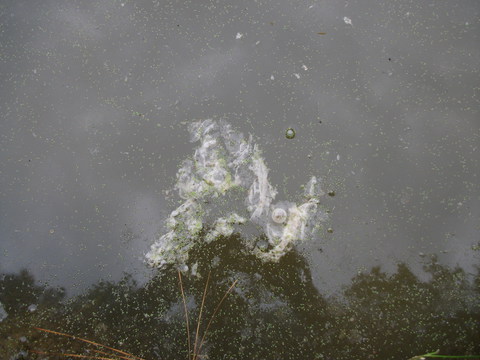
This looks like the duckweed in the Wiki.
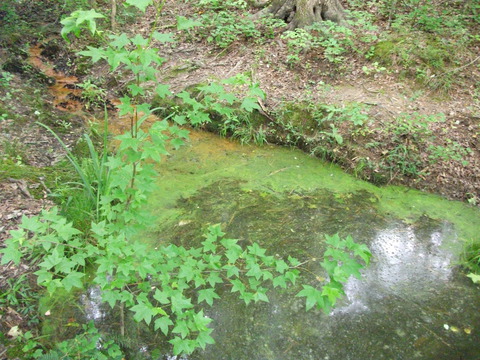
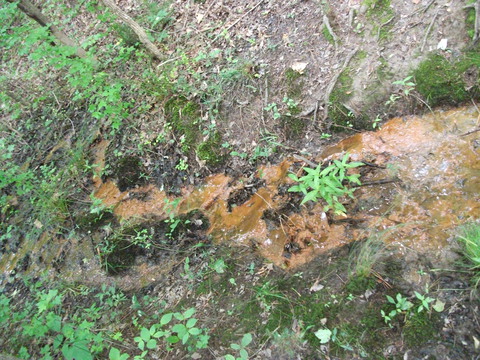
This is where the spring feeds the pond. What is this brown
gunk? It feels like liver!
Copyright (c) 2016, Larry Martin. All Rights Reserved.